

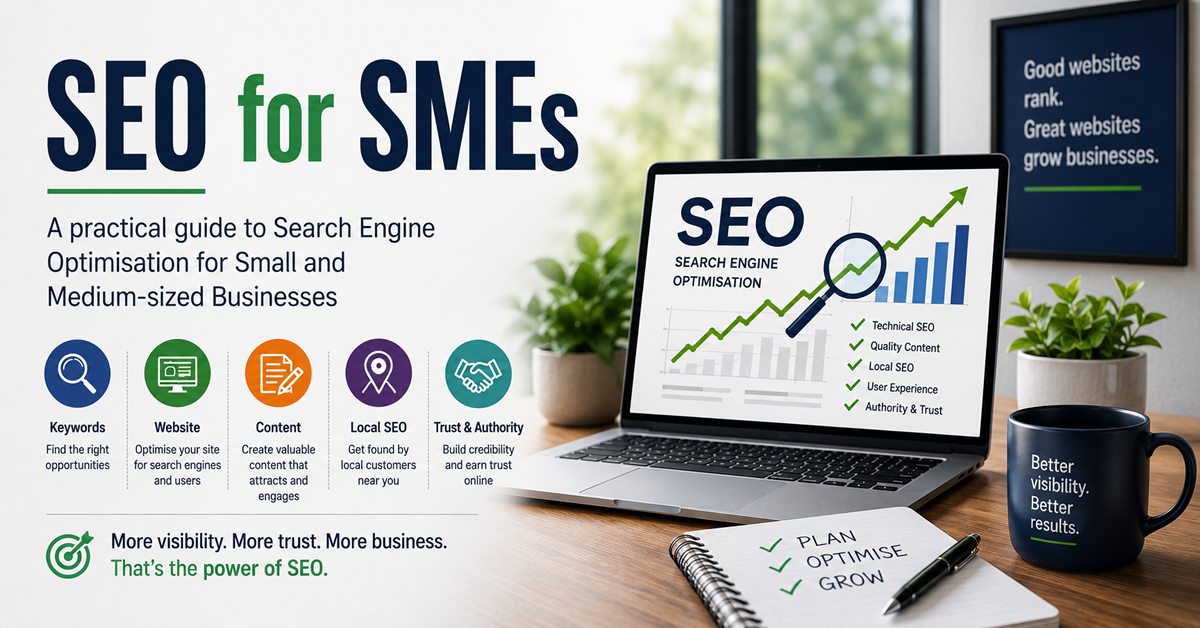
For many small and medium-sized enterprises (SMEs), the phrase “Search Engine Optimisation” (SEO) often feels like something reserved for large corporations with large marketing budgets and entire departments dedicated to digital growth.
In reality, SEO is often far more important for SMEs than it is for large organisations.
Why? Because smaller businesses rely heavily on visibility, trust and local discovery; if your business cannot be found when potential customers search for your services, your competitors will be.
SEO is not about gaming Google; it is about making your business easier to find, easier to trust and easier to choose.
This article explains the fundamentals of SEO, why it matters and how SMEs can approach it properly.
What is SEO?
Search Engine Optimisation (SEO) is the process of improving your website so that search engines such as Google can better understand, index and rank your content.
When someone searches for:
- “Commercial Heating Services Derby”
- “GDPR Consultancy for Small Businesses”
- “Electric Gate Servicing Near Me”
- “Dog Walking in Milford”
- “The King William”
- “Schools for Autism in the East Midlands”
Google decides which businesses appear first.
Good SEO improves your chances of appearing in those results organically; meaning without paying for advertisements.
This matters because most users trust organic search results more than paid adverts.
SEO is not one single task, it is the combined result of:
- Website Health
- Strong Content
- Keyword Relevance
- Trust Signals
- User Experience
- Authority and Reputation
- Consistent Maintenance
It is ongoing work, not a one-off fix.
Why SEO Matters for SMEs
Large companies can spend heavily on advertising; most SMEs cannot.
SEO creates long-term visibility without requiring continuous advertising spend.
A properly optimised website can:
- Generate enquiries consistently.
- Improve trust and credibility.
- Reduce reliance on paid ads.
- Support local business growth.
- Strengthen brand authority.
- Improve conversion rates.
This is especially important for service-based businesses where trust is a major deciding factor.
SEO is often one of the most cost-effective long-term investments an SME can make.
The Core Foundations of SEO
Website Structure and Technical Health
Search engines must be able to properly crawl and understand your website; this means your site should have:
- Fast loading speeds.
- Mobile-friendly design.
- Secure HTTPS connections.
- Clear navigation.
- Proper page titles and headings.
- Working internal links.
- Clean URL structure.
- No broken pages.
- Properly indexed pages.
Many SME websites fail here before content is even considered; a slow, poorly structured website can damage rankings, regardless of how good the services are.
This is why website design and management should always work alongside SEO rather than separately.
Keyword Strategy
Keywords are the phrases people type into search engines.
Good SEO starts with understanding:
What are your customers actually searching for?
Not what you call your service internally.
For example; instead of:
“Integrated Compliance Consultancy”
Your customers may search for:
- “GDPR help for small business”
- “Information security consultant UK”
- “ISO 27001 support for SMEs”
The wording matters; effective keyword strategy focuses on:
- Relevance
- Intent
- Search Behaviour
- Realistic Competition Levels
The goal is not traffic for the sake of traffic; the goal is attracting the right visitors.
High-Quality Content
Content is often where SMEs either succeed or fail; search engines favour websites that genuinely help users and this means creating useful content such as:
- Service Pages
- FAQs
- Case Studies
- Industry Guides
- Articles
- Problem-Solving Resources
Thin, generic pages rarely perform well; a strong article answering a real client problem can generate enquiries for years and this is why educational content often outperforms aggressive sales language.
Good content builds:
- Visibility
- Authority
- Trust
- Expertise
Not every page should sell; many pages should educate first.
Local SEO
For SMEs serving specific geographic areas, local SEO is critical; this includes:
- Consistent business details (name, address, phone).
- Local service pages.
- Location-based keywords.
- Review management.
- Local citations.
- Accurate business profiles.
If you operate across Derbyshire, Staffordshire, Leicestershire, and Nottinghamshire, for example, your website should clearly reflect that.
Search engines need location clarity and customers do too.
Authority and Trust Signals
Google asks a simple question; “can this business be trusted”?
Trust signals include:
- Professional Website Design
- Case Studies
- Genuine Testimonials.
- Secure Browsing
- Privacy Policies
- Clear Contact Details
- Industry Certifications
- Strong Backlink Profiles
- Demonstrated Expertise
This is particularly important in consultancy, compliance, security and professional services where credibility drives conversions.
SEO is as much about trust as it is rankings.
Common SEO Mistakes SMEs Make
Chasing Shortcuts
Buying backlinks, stuffing keywords, or using poor-quality AI-generated content may create short-term movement but often causes long-term damage.
Google gets better at identifying poor practices every year; sustainable SEO always wins.
Ignoring rxisting Website Problems
Many businesses focus on blogs while their core service pages are weak, outdated, or unclear; your service pages matter most and should be your strongest pages.
Treating SEO as a One-Off Project
SEO is not “finished”; competitors move, algorithms change and customer behaviour changes so SEO requires regular review and refinement.
Focusing on Rankings Instead of Enquiries
Ranking first for irrelevant traffic means very little; SEO should support business outcomes such as:
- Leads
- Enquiries
- Conversions
- Trust
- Retention
…not vanity metrics!
How I Support SMEs with SEO
At Stu Walsh Ltd., SEO is not treated as a standalone sales gimmick; it sits within broader business support, digital consultancy, compliance awareness and operational improvement.
This means SEO work is approached with commercial reality in mind:
- How customers actually find you.
- How your website supports trust.
- How content supports conversions.
- How compliance and professionalism affect rankings.
- How digital improvements support the wider business
Services include:
- Website Design and Management
- SEO Improvement
- Content Structure and Optimisation
- Policy and Compliance Alignment
- Digital Consultancy for SMEs
- Practical Business Support
The goal is simple; not just more traffic, but better business outcomes.
This practical, integrated approach is reflected across client testimonials and service delivery.
Conclusion
SEO is often misunderstood because too many providers sell it like magic; its not magic …it is structure, consistency, clarity, and trust.
For SMEs, good SEO is not about beating multinational corporations; it is about being found by the right people at the right time, it is about making sure that when someone needs exactly what you offer, they can find you and trust you enough to make contact.
That is where real growth begins.
SEO, done properly, becomes one of the most valuable investments your business can make.
If your business would benefit from practical SEO support, digital consultancy, or a stronger website foundation; please contact me via the form below:
Sources: