

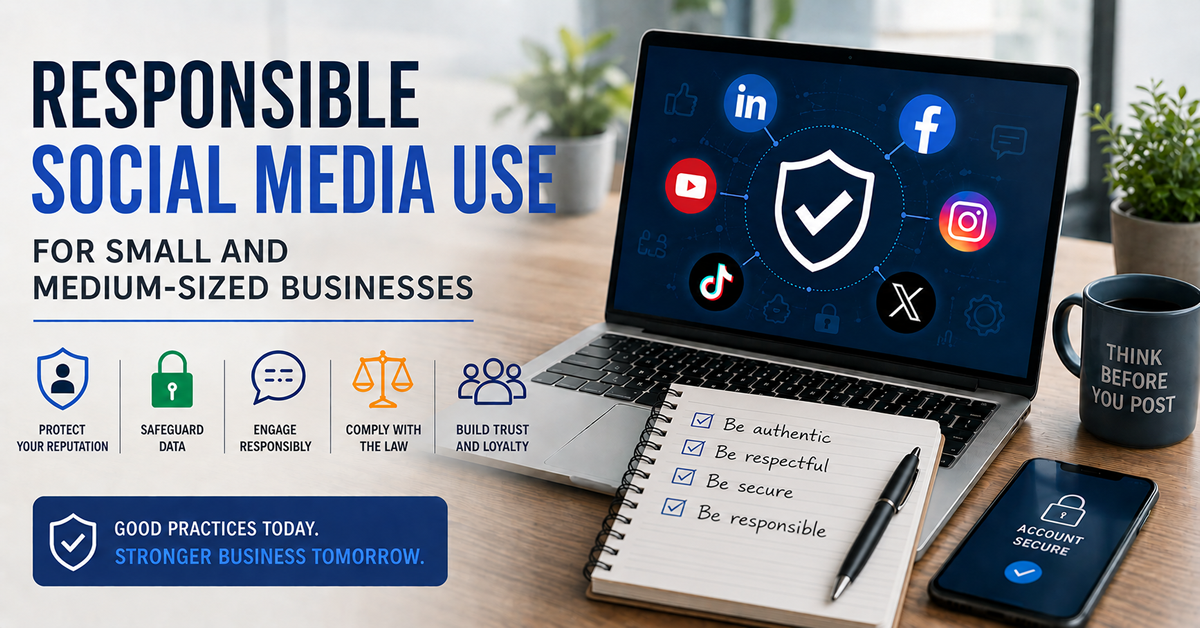
For most small and medium-sized businesses, social media has become part of daily operations rather than a separate marketing activity; it is where customers ask questions, leave complaints, check credibility and decide whether they trust a business enough to buy from it.
Platforms such as LinkedIn, Facebook, Instagram, X and TikTok are now central to visibility, lead generation, recruitment and customer trust.
But while social media offers reach and opportunity, it also introduces risk.
A rushed reply to a complaint, an employee posting confidential information, weak password protection on a company account, or direct marketing that breaches UK GDPR rules can create reputational and legal problems far bigger than many SMEs are prepared for.
For larger organisations, these issues may be handled by internal legal teams, communications departments and cybersecurity specialists; for SMEs, responsibility often falls to owners, office managers, or junior employees with limited guidance.
That is where problems begin.
Responsible social media use is not about being overly cautious or corporate; it is about ensuring your business communicates professionally, protects customer data and avoids preventable mistakes that can damage trust.
Social Media Is a Business Function, Not a Hobby
Many businesses still treat social media as something informal; an extra task completed between “real work”.
That mindset is dangerous.
If your business uses social media to promote services, respond to customers, collect enquiries, or communicate with employees and suppliers; it is part of your operational infrastructure.
That means it affects:
- Brand Reputation
- Customer Relationships
- Data Protection Compliance
- CyberSecurity Exposure
- Recruitment and HR Risk
- Legal Liability
- Commercial Credibility
The Information Commissioner’s Office (ICO) makes it clear that organisations must comply with UK data protection law whenever they handle personal data; including customer enquiries, marketing contacts and employee information. This applies to small businesses just as much as large ones.
A customer sending personal details via Facebook Messenger is still a data protection issue, an employee using customer photos on Instagram without consent is still a compliance issue and a director arguing publicly with a client on X is still a reputational issue.
The platform changes but the responsibility does not.
Every SME Needs a Clear Social Media Policy
One of the simplest and most effective controls is a written social media policy.
This does not need to be lengthy; in fact, most policies fail because they are too vague or too legalistic.
A good policy should explain who Can Speak for the Business; not everyone should have posting authority.
Define:
- Who manages official accounts.
- Who approves campaigns or sensitive posts.
- Who handles customer complaints.
- Who responds during incidents or emergencies.
This avoids inconsistency and reduces the risk of poor judgment made in haste.
Personal Use Still Has Professional Consequences
Employees are entitled to personal lives, but public behaviour online can affect employers.
Complaints about customers, offensive remarks, breaches of confidentiality, or public criticism of colleagues can all create reputational damage.
Policies should focus on professionalism, respect and confidentiality; not unnecessary surveillance.
Confidential Information Must Stay Confidential
Employees should never casually share:
- Client Names
- Financial Information
- Employee Records
- Supplier Contracts
- Internal Disputes
- Security Arrangement
- Legal matters
Even well-meaning “behind the scenes” content can expose far more than intended.
Data Protection Applies to Social Media Too
This is where many SMEs get caught out.
The UK GDPR does not care whether information came through email, a Customer Relationship Management (CRM) system, or social media; if personal data is being processed, the law applies.
The UK Government states businesses must:
- Collect only necessary data.
- Use it only for specified purposes.
- Keep it secure.
- Tell people how it is used.
- Allow access, correction, or deletion where required.
The ICO also confirms that businesses need a privacy notice explaining how personal data is collected, used, stored and shared.
This matters on social media because customers often share information publicly without realising the consequences.
A customer posting account details in a comment section should trigger immediate action and not silence.
Responsible businesses remove unnecessary exposure and move sensitive conversations to secure private channels.
Direct Marketing Rules Are Often Misunderstood
Many SMEs assume that if contact details are publicly available; especially on LinkedIn, they are free to use for marketing.
That is not automatically true.
The ICO makes clear that if personal data is used for direct marketing, businesses must comply with both UK GDPR and the Privacy and Electronic Communications Regulations (PECR); this includes marketing by email, text and even direct messages on social media platforms.
Simply finding someone’s details online does not mean they have consented to unsolicited marketing.
Businesses must consider lawful basis, transparency and the individual’s right to object.
Poorly handled outreach is not just ineffective; it can be unlawful.
Security Risks Often Start With Social Media
CyberSecurity failures do not always begin with technical breaches; often, they begin with human behaviour.
Attackers use social platforms to:
- Impersonate suppliers.
- Target employees through phishing.
- Gather operational intelligence.
- Identify internal structures.
- Exploit trust through fake accounts.
A fake message on LinkedIn can be more dangerous than a suspicious email because people tend to trust familiar platforms; business accounts themselves are also frequent targets.
Weak passwords, shared access and missing Multi-Factor Authentication (MFA) make account takeover far too easy.
Once compromised, attackers can:
- Scam customers.
- Distribute malicious links.
- Damage public trust.
- Impersonate directors.
- Access connected advertising accounts.
The ICO advises organisations to process personal data securely using appropriate technical and organisational measures; that includes social media accounts.
Security is not just an IT issue.
Shared Passwords Are Not a System
Many SMEs still operate with “the Facebook password” written somewhere in the office; that is not governance …it is risk.
Best practice includes:
- Individual access permissions.
- Strong unique passwords.
- Password manager use.
- MFA.
- Immediate access removal when employees leave.
- Regular review of administrator rights.
If a former employee still controls your company page, you do not have account security; you have luck …and luck runs out.
How You Handle Complaints Matters More Than the Complaint
Negative feedback is inevitable; the real test is how a business responds.
Public arguments, defensive replies, or silence often create more damage than the original issue.
Customers pay attention to professionalism under pressure.
Good responses are calm, respectful, proportionate, solution-focused and moved to private channels when necessary.
The goal is not to “win” the argument; it is to protect trust.
Reputation is often shaped most strongly by how businesses behave when things go wrong.
Leadership Sets the Standard
Culture starts at the top; if directors behave recklessly online, employees will assume standards are optional.
If leadership treats CyberSecurity casually, employees will too.
If senior people ignore professionalism, policies become meaningless.
Responsible social media culture requires leaders to display:
- Professionalism
- Restraint
- Consistency
- Security Awareness
- Respect for Confidentiality
People follow behaviour faster than they follow policy documents.
Training Prevents Expensive Mistakes
Most social media incidents are not malicious; they are careless.
- Someone clicks the wrong link.
- Someone shares too much.
- Someone responds emotionally.
- Someone assumes “it will be fine”.
Training matters because common sense is not a compliance strategy.
Employees should understand:
- Phishing and impersonation risks.
- Confidentiality boundaries.
- Complaint handling.
- Marketing compliance.
- Password security.
- Escalation procedures.
Even short, practical awareness sessions can prevent serious problems and prevention is always cheaper than recovery.
Conclusion
Social media gives SMEs extraordinary reach; it also gives them extraordinary exposure.
Used well, it builds trust, authority, and growth; used badly, it creates legal risk, security failures, and reputational damage at remarkable speed.
Responsible social media use is not about restricting personality or sounding corporate; it is about protecting the business.
It means clear expectations, proper security, lawful marketing, professional leadership and employees who understand where the real risks lie.
In business, reputation takes years to build and minutes to lose; social media simply accelerates both.
The question is not whether your business should use social media; it is whether you are using it responsibly.
Does Your Business Rely On Social Media
At Stu Walsh Ltd, we help SMEs strengthen their information security, improve compliance and reduce the everyday risks that often go unnoticed until they become serious problems. From social media governance and staff awareness training to GDPR consultancy, cybersecurity strategy and risk management; we provide practical support that works in the real world, not just on paper.
If you would like to review your current social media risks, improve your policies, or strengthen your wider security framework; get in touch today.