

In a small business, it’s surprisingly easy for important processes to exist entirely inside someone’s head.
Someone knows how the invoices are raised, someone else knows which spreadsheet needs updating each month; there’s usually a person who knows where a particular document is kept or what needs to happen when something goes wrong.
And for a while, that can work perfectly well; the problem comes when that person isn’t there.
They might be on holiday, off sick, leave the business or simply be too busy to deal with something; suddenly, a task that has been carried out without a second thought for years becomes much more difficult because nobody ever wrote down how it was done.
That’s really all a documented process needs to solve.
It doesn’t need to be a twenty-page procedure or an impressive-looking manual; it just needs to give someone enough information to understand what needs doing and how to do it.
You Can’t Keep Everything in Your Head
When there are only a few people in a business, informal ways of working often make sense; people talk to each other; questions can be answered quickly and everyone gradually learns how things work.
As the business gets busier, though, relying on memory becomes harder.
Something as routine as producing a monthly report can involve lots of little details that the person doing it barely thinks about anymore; they know where the figures come from, which template to use, who needs to see it and where the finished version should be saved.
Ask somebody else to take over and suddenly those details become important; that’s when you discover how much business knowledge has never actually been written down.
Make Processes Useful, Not Complicated
I think this is where businesses can easily go too far; documenting processes shouldn’t mean creating paperwork for the sake of it.
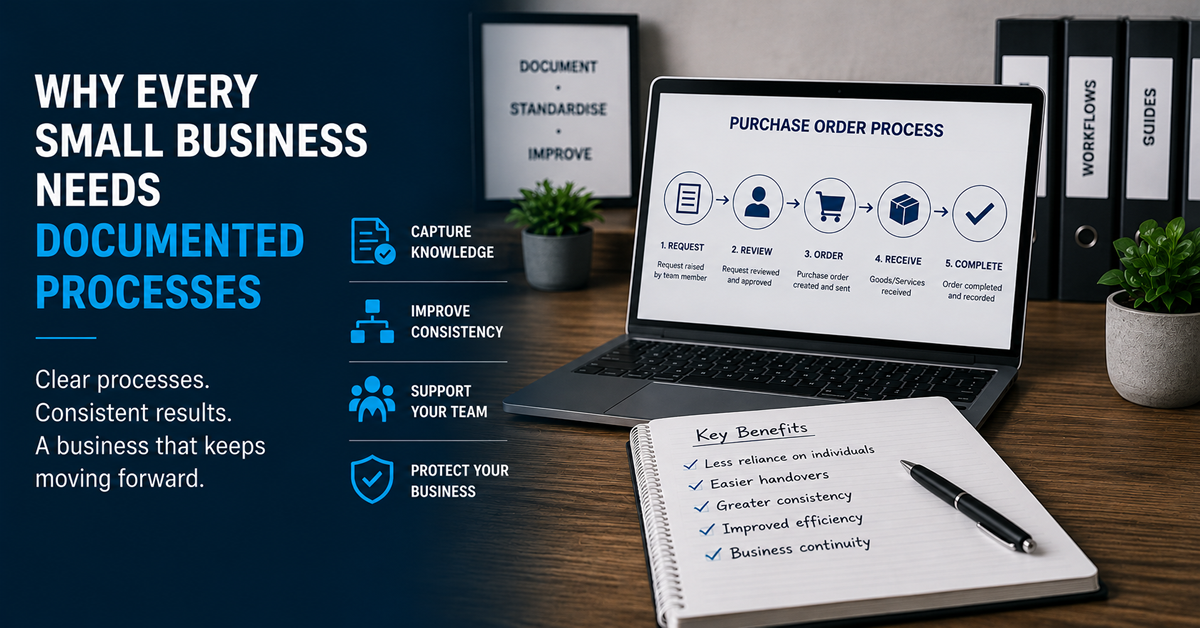
Some tasks might need a detailed procedure, others might only need a page of straightforward instructions. Screenshots can sometimes explain something better than several paragraphs, while a simple flowchart might make sense for a process involving several decisions.
There’s no prize for producing the longest document; what matters is whether somebody can use it.
If a colleague who’s unfamiliar with a task can read the process and get a reasonable idea of what they need to do, it’s serving its purpose.
Writing things down can also reveal some interesting habits; a process may contain a step that nobody really needs anymore. The same information might be entered into two different systems; perhaps something requires approval simply because it always has, even though nobody can remember why.
It’s surprising how often “we’ve always done it that way” survives until somebody actually looks at the whole process from beginning to end.
Don’t Let Knowledge Walk Out of the Door
People naturally build up a huge amount of knowledge about their jobs; much of it is never formally recorded because there’s never been a reason to record it …they simply know what to do.
That becomes a problem when the business depends too heavily on one person.
If they’re unexpectedly unavailable, other people can find themselves trying to piece together a process from old emails, previous documents and educated guesses.
Writing down important processes gives the business a little more protection against that; it also makes handing work over much easier. New employees have something to refer to, colleagues can cover for each other and customers are more likely to receive a consistent service regardless of who happens to be dealing with them.
The aim isn’t to remove people’s judgement or force everyone to work like a machine; it’s simply to make sure important knowledge belongs to the business as well as the individual.
Don’t Write It and Forget It
There’s little value in having a perfectly organised folder full of procedures if nobody has looked at them since 2021; businesses change, software gets replaced, responsibilities move around and processes that once made perfect sense gradually become outdated …documentation needs to keep up.
That doesn’t mean reviewing every document every month; it means updating a process when something significant changes and occasionally checking that what’s written down still resembles what people actually do.
It’s also worth being sensible about what you document; not every task needs a procedure.
Start with the things that would cause a genuine headache if the person who normally handled them wasn’t available; regular financial tasks, customer processes, important administrative work, compliance activities and anything involving key business information are usually sensible places to look.
You can build from there.
Conclusion
For me, documented processes aren’t about creating more bureaucracy; they’re about making a business less dependent on memory.
They help people cover for each other, make it easier to bring somebody new into a role and give everyone a clearer idea of how important work should be done; sometimes they also expose processes that could have been made simpler years ago.
You don’t need to document everything at once, and you certainly don’t need an enormous procedures manual.
Start with something important; write down how it’s actually done, then ask someone else whether they could follow it and perhaps the most useful question of all is this:
If the person who normally handles an important part of your business wasn’t available tomorrow, would everyone else know what to do? If not, you’ve probably just found your first process to document.
Make Your Business Easier to Run
If too much of your business relies on people simply knowing what to do, it might be time to write some of that knowledge down.
I can help you turn the way you already work into clear, useful processes that people can actually follow.
Get in touch for a friendly, no-obligation chat.