


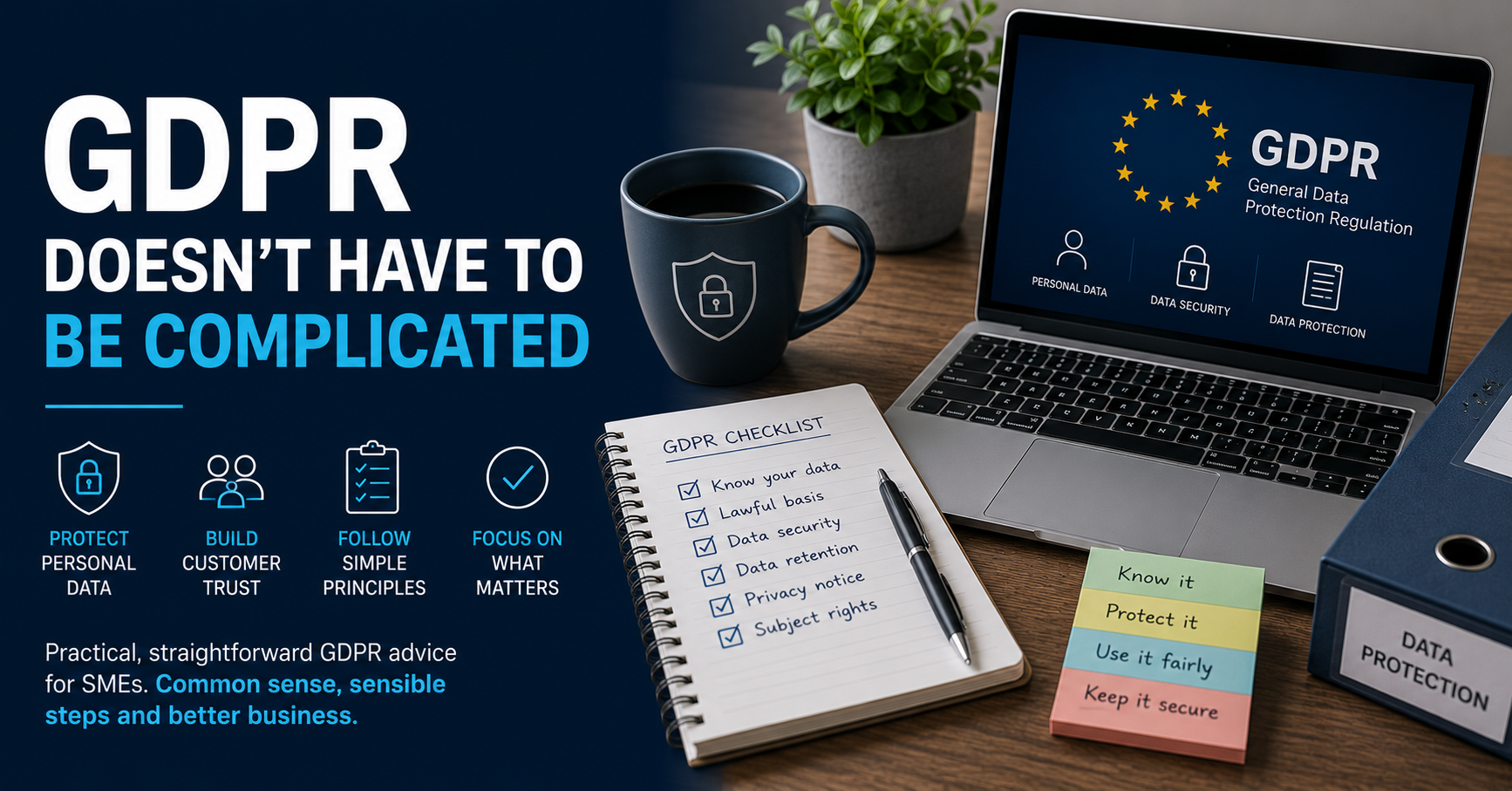
One thing I’ve noticed over the years is that the moment somebody mentions the General Data Protection Regulation (GDPR), many business owners seem to brace themselves.
They expect complicated legislation, endless paperwork and the risk of eye-watering fines and I understand why …that’s often how it’s been portrayed.
But in my experience, most small businesses don’t have a GDPR problem; they have an organisation problem.
I’ve worked with organisations where customer information was spread across laptops, shared drives, email folders and filing cabinets; nobody was entirely sure which version of a document was the latest, who had access to what or how long records had been kept.
That’s far more common than most people realise; the good news is that it’s usually much easier to fix than people think and it Starts With Common Sense
I’ve never met anyone who started a business because they wanted to spend their evenings writing privacy policies; fortunately, that’s not what good data protection is really about.
At its core, it’s simply about treating people’s personal information responsibly; if you collect somebody’s name, address or email address, they expect you to keep it safe, they expect you to use it for the reason they gave it to you and they expect you not to lose it or share it carelessly.
When you strip away the legal language, that’s really what it’s all about.
You’re Probably Already Doing More Than You Think
One misconception I come across regularly is that businesses believe they need to start from scratch; in reality, most SMEs are already doing many of the right things:
- You probably lock your office.
- You probably protect your devices with passwords.
- You probably think twice before sharing customer information.
- You probably shred confidential paperwork instead of throwing it in the bin.
Those aren’t just good habits; they’re good business practices.
The next step is making sure those habits are consistent across the business rather than depending on one person’s memory.
The Questions I Usually Ask
When I’m helping a business review how it handles personal information, I rarely start by asking to see a folder full of policies; instead, I ask questions like:
- Where is customer information stored?
- Who can access it?
- Why do you need it?
- How long do you keep it?
- What happens when somebody leaves the business?
- If a customer asked what information you held about them, could you find it?
The answers usually tell me far more than a stack of documents ever could.
Focus on Everyday Risks
When people think about data protection, they often imagine sophisticated cyber attacks or international hackers.
Those things happen; but they’re rarely the issues I see most often, t’s usually much simpler than that i.e. an email sent to the wrong recipient, a lost laptop, weak passwords, old customer records that nobody has looked at for years, confidential documents left on a printer, etc.
Addressing those everyday risks often makes a much bigger difference than worrying about unlikely scenarios.
Good Documentation Helps; But Keep It Practical
I’m a strong believer in good documentation.
After all, clear procedures help businesses stay organised and consistent; But documentation should support the way your business operates, not become a burden.
I’ve seen organisations with shelves full of policies that nobody had opened in years and I’ve also worked with businesses that had a handful of straightforward, well-written documents that everyone actually understood.
I’d choose the second approach every time.
A simple Privacy Notice, sensible procedures and a basic understanding of how information flows through your business will usually achieve far more than producing paperwork simply for the sake of it.
Every Business Is Different
A local business with three employees doesn’t need the same level of documentation as a national organisation with hundreds of staff; that’s something I think people often forget.
The principles are the same, but the way they’re applied should always be proportionate to the size and complexity of the business.
There’s no benefit in creating complicated processes that nobody will ever use; simple, practical and realistic is usually the better approach.
Nobody Gets Everything Right
I’ve made mistakes over the years, every business has, the important thing isn’t pretending they never happen; it’s recognising them, putting them right and learning from them.
Good data protection isn’t about achieving perfection; it’s about building sensible processes that reduce the likelihood of mistakes and make it easier to deal with them if they do occur.
Conclusion
Looking back over my career, the businesses that handled data protection best weren’t necessarily the ones with the thickest folders or the longest policies; they were usually the businesses that knew exactly what information they held, understood why they needed it and treated it with respect.
Everything else was there to support those simple principles, that’s why I don’t see data protection as a legal exercise; I see it as part of running a well-organised business.
If you understand your information, keep it organised, review it regularly and treat it responsibly, you’re already a long way towards doing the right thing.
In my experience, GDPR becomes much less intimidating once you stop thinking about legislation and start thinking about people.
GDPR Doesn’t Have to Be Overwhelming
If you’re unsure where to start with GDPR or would like a fresh pair of eyes on your current processes, I’d be happy to help. Together, we can take a practical, straightforward approach to protecting your business and your customers’ information.
Get in touch for a friendly, no-obligation chat.