


I don’t think I’ve ever met a business owner who complained about having too little to do; if anything, it’s usually the opposite.
There are always emails to answer, customers to speak to, paperwork to complete and another job waiting before you’ve even finished the first one.
The challenge isn’t usually finding work; it’s deciding what deserves your attention first.
Over the years, I’ve realised that being busy doesn’t automatically mean you’re being productive; some of the busiest people I know spend their entire day reacting to other people’s priorities, only to wonder why their own workload never seems to get any smaller.
Learning to prioritise properly can make a huge difference; not just to your business, but to your stress levels too.
Start With What Really Matters
Earlier in my career, I’d often begin the day by opening my inbox and working through emails one by one, it felt productive; the reality was that by lunchtime I’d spent hours responding to other people’s requests while the work that would have made the biggest difference was still sitting untouched.
Now I try to ask myself one simple question before I start: “If I only completed one task today, what would have the biggest positive impact?”
It’s surprising how often the answer isn’t sitting at the top of your inbox.
Busy Isn’t Always Productive
One mistake I see regularly is treating every task as though it’s equally important; it rarely is.
Some jobs genuinely need doing today, others can wait until tomorrow, some can be delegated and a few probably don’t need doing at all.
Just because something is shouting the loudest doesn’t mean it deserves your attention first.
A Five-Minute Exercise
If your workload is starting to feel overwhelming, grab your to-do list and spend five minutes asking yourself these questions.
- Which task will have the biggest impact on the business?
- Which task helps generate income?
- Which task improves the way the business operates?
- Which task only feels urgent because somebody else wants it done?
- Which task could realistically wait until tomorrow?
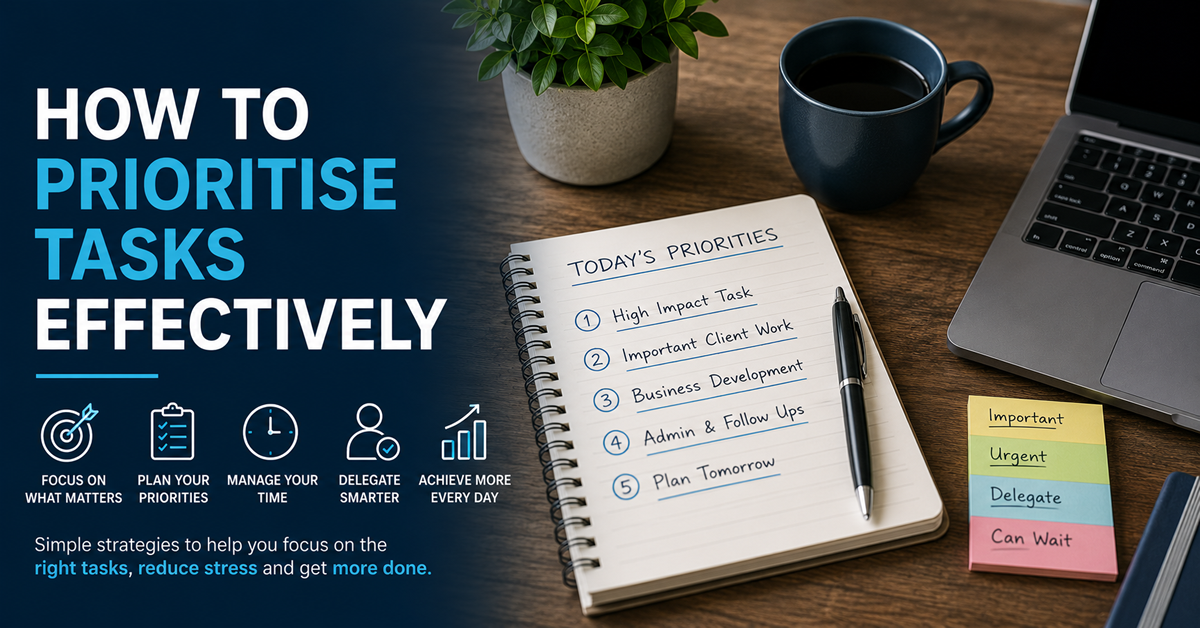
You don’t need an expensive productivity app to answer those questions; sometimes a pen, a notebook and a few minutes of honest thinking are all that’s required.
Break Big Jobs Into Smaller Ones
Large projects have a habit of sitting untouched for weeks; not because they’re difficult, but because they feel overwhelming.
“Redesign the website” sounds like a major project but “Review the Home page” feels achievable.
Whenever a task feels too big to start, I break it into smaller steps; once you’ve completed the first one, the rest usually become much easier.
Stop Switching Between Tasks
I’ll admit this is something I still have to keep an eye on myself.
It’s tempting to answer one email, start writing a document, take a phone call, reply to a message and then wonder where the last hour disappeared.
Every time you change tasks, your brain needs a few moments to refocus and those moments soon add up; I’ve found it’s far more effective to group similar work together i.e. reply to emails at set times, prepare documents in one session and complete administrative work together.
Not only do you work more efficiently, but the quality of your work often improves too.
Ask Yourself One Important Question
Whenever something new lands on my desk, I try to ask myself: “Am I the only person who can do this?”
If the answer is no, it might be something that could be delegated now or in the future.
Delegation isn’t about avoiding work; it’s about making sure your time is spent where it creates the greatest value.
As businesses grow, that’s one of the biggest mindset shifts owners have to make.
Don’t Chase the Perfect System
Personally, I think productivity apps get far more attention than they deserve; don’t get me wrong, they can be useful.
But I’ve seen plenty of well-organised businesses run perfectly well using little more than a diary, a notebook and a clear understanding of what needs doing first.
The system isn’t what makes the difference; using it consistently does.
Accept That the List Will Never Be Empty
One thing I’ve stopped trying to achieve is the mythical empty to-do list; I’ve never managed it and I suspect most business owners never will.
There will always be another enquiry, another meeting, another invoice or another email waiting for your attention.
I’ve found it’s far healthier to measure success by the progress you’ve made rather than the number of boxes you’ve ticked; I’d rather complete three important tasks properly than rush through twenty that make very little difference.
Conclusion
Looking back over the years, I’ve never regretted spending time improving a process, helping a customer or working on something that genuinely moved a business forward but I have regretted spending hours reacting to things that only felt urgent at the time.
Prioritising isn’t about squeezing more hours into the day; it’s about making better decisions with the hours you already have.
Nobody gets it right all the time; I certainly don’t.
But if you consistently focus on the work that creates the greatest value, you’ll usually achieve far more than simply trying to do everything at once.
At the end of the day, productivity isn’t measured by how busy you are; it’s measured by the difference your work actually makes.
Spend More Time on What Matters
If you’re finding yourself buried in administration or struggling to keep on top of competing priorities, I can help you organise your workload, improve your processes and free up valuable time.
Get in touch for a friendly, no-obligation chat about how I can support your business.


