

Ask most business owners what keeps their business running day to day and they’ll probably mention good staff, loyal customers or a healthy bank balance; very few will say “documentation”.
I understand why; documents don’t win new customers or generate sales, and nobody starts a business because they’re excited about writing procedures or organising files.
But over the years I’ve come to appreciate just how valuable good documentation can be.
I’ve seen businesses grind to a halt because nobody knew where something was stored, I’ve seen people waste hours looking for the latest version of a document and I’ve even seen simple jobs delayed because the one person who knew how to do them happened to be on holiday.
None of those businesses had a people problem; they had a documentation problem.
The good news is that it doesn’t take dozens of policies or a shelf full of manuals to make a real difference; in fact, I think most SMEs can dramatically improve the way they operate with just a handful of well-thought-out documents.
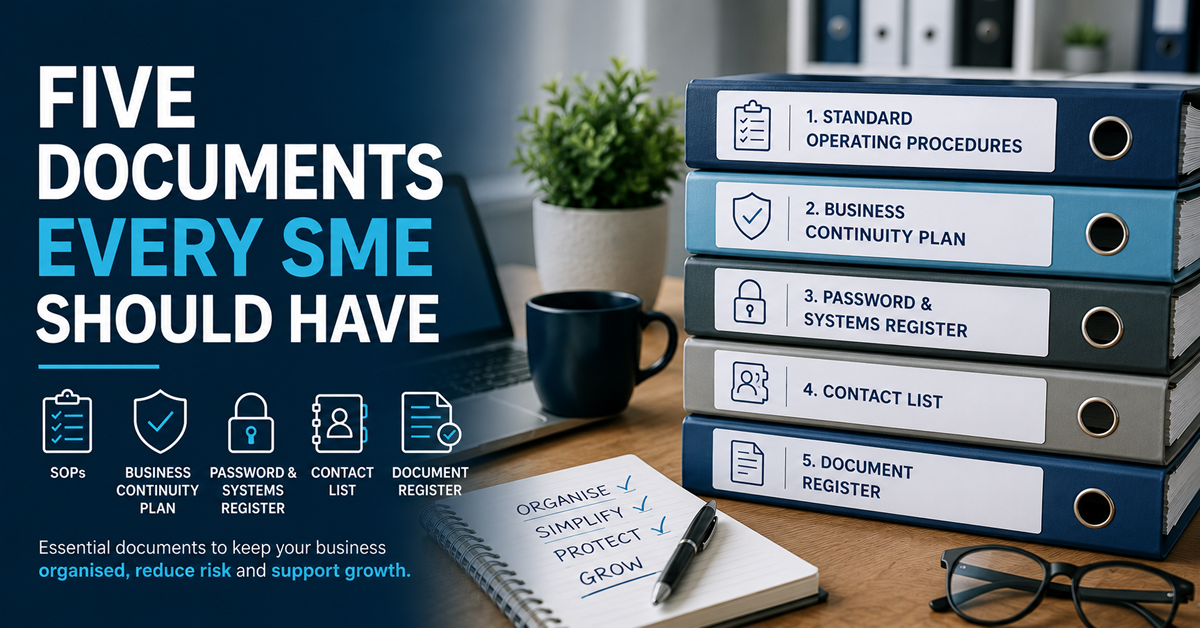
These are the five I’d start with:
1. Standard Operating Procedures (SOPs)
If somebody joined your business tomorrow, could they complete one of your regular tasks without needing you to explain it? bIf the answer is no, that’s probably the first document I’d create.
Standard Operating Procedures, or SOPs, are simply step-by-step guides for the jobs your business carries out regularly; that could be responding to enquiries, preparing quotations, onboarding new customers or updating your website.
Personally, I’d much rather spend half an hour writing a simple procedure once than answer the same question twenty times over the next six months.
The important thing is not to overcomplicate them; a clear one-page guide that’s actually used is worth far more than a fifty-page manual that nobody ever opens.
A Quick Test…
Imagine you couldn’t come into work tomorrow; would somebody else know:
- How to prepare a quotation?
- Where your important documents are stored?
- How to contact your key customers or suppliers?
- Which systems they need to access?
- What tasks absolutely have to happen that day?
If you’re hesitating over several of those questions, it’s probably a good indication that your business relies more on memory than documentation.
2. A Business Continuity Plan
Nobody likes planning for things to go wrong; but unexpected problems don’t usually arrive with much warning.
- Power cuts.
- Internet outages.
- Illness.
- Cyber incidents.
- Flooding.
- The sudden loss of a key supplier.
A Business Continuity Plan doesn’t need to cover every possible scenario; it simply needs to help you answer one question: “How do we keep the business running?”
Even a straightforward document listing your critical activities, key contacts and immediate priorities can make an enormous difference when things don’t go according to plan; hopefully you’ll never need it, but if you do, you’ll be very pleased you took the time to create it.
3. A Password and Systems Register
This is something I’ve come across more times than I can remember; a business relies on an online system, but only one person knows how to access it.
Everything works perfectly until that person is away, changes role or leaves the business; suddenly, what should have been a five-minute task turns into a morning spent resetting passwords and contacting software providers.
I’m not suggesting storing passwords in an unsecured spreadsheet or writing them on sticky notes; quite the opposite.
Using a trusted password manager alongside a simple register showing which systems your business uses, who has access and where accounts are managed can save a huge amount of frustration later.
4. A Customer and Supplier Contact List
This sounds incredibly simple and that’s because it is.
But it’s surprising how many businesses have customer information spread across emails, mobile phones, accounting software and handwritten notes.
When everything is stored in different places, finding the right information often takes longer than it should; a single, regularly updated contact list gives everyone confidence that the information they’re using is accurate and current.
Sometimes the simplest documents turn out to be the most useful.
5. A Document Register
If your business has policies, templates, contracts, forms or procedures, you also need to know exactly where they are and which version is current; otherwise it’s very easy for multiple versions to appear over time.
We’ve all seen folders containing files called Policy Final, Policy Final Updated and somehow Policy Final Latest 2; or something similar.
It’s amusing until someone uses the wrong one.
A document register doesn’t need to be complicated; it’s simply a record of your important documents, where they’re stored, who owns them and when they were last reviewed.
It brings order to something that can otherwise become surprisingly messy.
Documentation Should Make Life Easier
One of the biggest misconceptions about documentation is that it’s all about compliance and bureaucracy. Personally, I don’t see it that way; good documentation saves time, It reduces mistakes, It helps people work consistently, It makes training easier and most importantly, it stops your business depending entirely on one person remembering how everything works.
That’s valuable whether you employ two people or two hundred.
Start Small
Don’t try to document everything in a single weekend (it probably won’t happen); instead, think about the question you’re asked most often or the task you explain repeatedly.
Start there, write it down, use it for a few weeks, improve it and then move on to the next document; small improvements made consistently almost always achieve more than ambitious plans that never quite get finished.
Conclusion
Looking back over my career, I’ve noticed that the best organised businesses aren’t always the biggest or the busiest; they’re usually the ones where people know where things are, understand how things are done and don’t rely on one individual to keep everything moving.
Good documentation creates that confidence.
It removes uncertainty, helps people work more consistently and makes businesses far more resilient when something unexpected happens; it doesn’t have to be perfect, it just has to be useful.
Ultimately, if spending an hour creating a simple document saves your business several hours, or even days of frustration in the future, I’d say that’s time very well spent.
Could Your Business Be Better Organised?
If your business could benefit from clearer documentation, better organised processes or practical administrative support; I’d be happy to help.
Get in touch for a friendly, no-obligation chat about how we can make your business easier to run.