


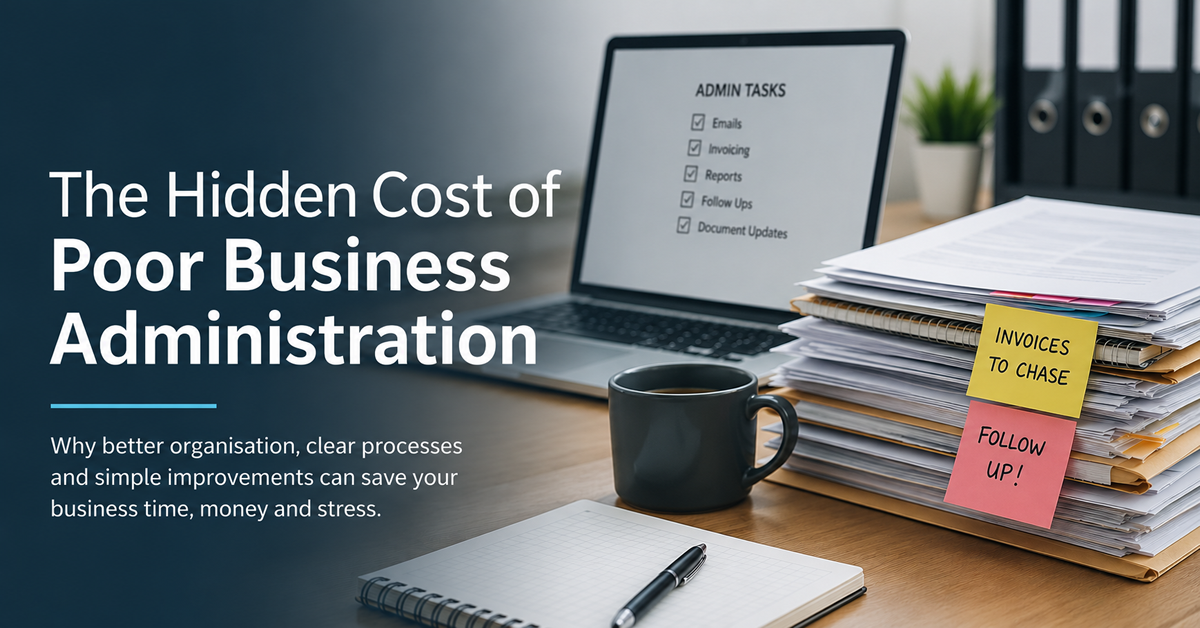
Ask most business owners what keeps them awake at night and you’ll probably hear the same answers: finding new customers, keeping an eye on cash flow, or trying to stay ahead of the competition; very few people mention business administration.
In my experience, that’s a mistake; over the years, I’ve worked with businesses of all sizes, from small family-run companies to organisations with hundreds of employees. One thing I’ve noticed is that many of the problems businesses face aren’t caused by a lack of talent or ambition; more often than not, they’re the result of small administrative issues that have gradually built up over time.
Individually, they’re easy to ignore. Collectively, they can become expensive.
Administration Isn’t Just Paperwork
Business administration has an unfortunate reputation; for many people, it conjures up images of filing cabinets, spreadsheets and endless paperwork.
The reality is very different; it’s the collection of everyday tasks that keep a business moving. Managing emails, preparing quotations, organising documents, scheduling meetings, keeping customer records up to date, raising invoices, tracking projects and making sure everyone knows what’s happening.
When these things are working well, nobody really notices them; when they’re not, the effects spread surprisingly quickly.
Where Does the Time Go?
One of the biggest hidden costs is time; not the obvious kind, but the five minutes spent looking for a document that should have been easy to find, the ten minutes trying to work out whether an invoice has already been sent or the fifteen minutes searching through email chains because nobody can remember the last conversation with a customer.
It doesn’t sound like much; but multiply those small delays across every day, every member of staff and every week of the year and the amount of lost productivity soon becomes significant.
Memory is a terrible filing system; if your business relies on people remembering where something is or what happened last week, sooner or later you’ll run into problems.
It’s Rarely One Big Mistake
Businesses rarely fail because of a single administrative error; instead, it’s usually a series of small issues.
An enquiry sits unanswered for a few days because everyone assumed someone else would reply, an outdated document is sent to a customer, a deadline slips because nobody realised it was approaching or an invoice is forgotten.
None of these mistakes are particularly dramatic on their own; but together they create unnecessary stress, extra work and, in some cases, lost revenue.
Good administration isn’t about eliminating every mistake; it’s about making those mistakes far less likely to happen.
Customers Notice More Than You Think
Customers don’t usually see your internal systems, but they notice the results. If they’re waiting days for a reply, receiving conflicting information or having to chase for updates, it doesn’t leave the best impression. On the other hand, businesses that communicate clearly, respond promptly and appear organised naturally inspire confidence.
Professionalism isn’t just about the quality of your product or service; it’s about every interaction your customer has with your business.
Growth Can Expose Weaknesses
Many businesses cope perfectly well when they’re small; then they grow.
More customers mean more enquiries, more projects, more paperwork, more deadlines and more people involved.
Suddenly, the informal way of doing things that worked perfectly a year ago starts becoming a problem.
I’ve seen businesses reach a point where everything depends on one person knowing where things are or remembering how something is done. That might work for a while, but it’s not a sustainable way to operate.
The businesses that grow successfully are usually the ones that build systems before they desperately need them.
Administration Supports Compliance Too
Good administration isn’t just about being organised; it also helps reduce risk.
Whether you’re keeping financial records, managing customer information or maintaining important business documents, having clear processes makes life much easier; it can also make demonstrating compliance with legal or contractual requirements far less stressful.
I’ve spent a large part of my career working in information security and compliance, and one lesson comes up time and time again; businesses with organised records generally find audits, inspections and customer requests much easier to deal with than those relying on scattered files and someone’s memory.
Small Changes Often Have the Biggest Impact
The good news is that improving your administration doesn’t usually require a major overhaul; in fact, some of the most effective improvements are also the simplest.
Creating consistent file names, agreeing where documents should be stored, using templates for regular tasks, documenting routine processes instead of relying on memory, reviewing your administrative systems every few months to make sure they’re still working; none of these changes are particularly exciting, but together they can save hours of unnecessary work over the course of a year.
Conclusion
I think business administration has an image problem.
People often see it as something that gets in the way of “real work”, when in reality it helps make that work possible.
Looking back over my career, the businesses that seemed calm, organised and successful weren’t necessarily working harder than everyone else. They’d simply invested time in building reliable systems and processes that supported the way they worked.
Nobody starts a business because they’re passionate about organising folders or creating process documents. That’s understandable.
But taking the time to get those fundamentals right gives you something that’s far more valuable than a tidy filing system. It gives you more time to focus on your customers, your team and the future of your business.
Good administration isn’t glamorous, and it probably never will be.
What it is, however, is one of the simplest ways to make your business more efficient, more resilient and far easier to grow.
Could Your Business Run More Efficiently?
If poor administration is costing your business valuable time, I can help streamline your processes, improve organisation and take routine tasks off your hands.
Get in touch for a no-obligation chat.